‘Hi all. It’s been a tumultous year so far for me. In February, I started to suffer from the consequences of long-term diabetes, and it resulted with my having to have my lower left leg amputated in June.
Sadly, this meant that our summer dig, planned for the start of July, had to be cancelled. I have not been able to go out to Caer Alyn since my hospizalitation, but the core team are going out & continuing work on Trench 14.
It may take some time but I am hoping to get a prosthetic, which means I can return to site. Archaeology hasn’t got rid of me yet! And we hope to get some reports on recent digs out in the next few months.’
Adding to Alan’s update : Alan, hopefully, will be coming to Caer Alyn next Saturday (10th of August 2025). Although he will not be able, yet, to get down to the trenches he can be on site!!
New Update
14th June 2026
Hi all.In the last few weeks, weather permitting, we have been working on Trench 14A, which is situated on the eastern edge of the plateau, close to the Bronze Age tumulus.
Excavations which began in this area in 2005 revealed a stone-lined chamber set into the edge of the plateau, which is believed to date from the late medieval/early post-medieval period (Trench 14). A shallow earth bank capped by a layer of medium to large stones, running on an approximate north-east to south-west alignment, ran immediately above this feature. This bank was accompanied by a ditch on its western side. Trench 14A was originally opened in 2007, in part to examine a further length of the bank and ditch.
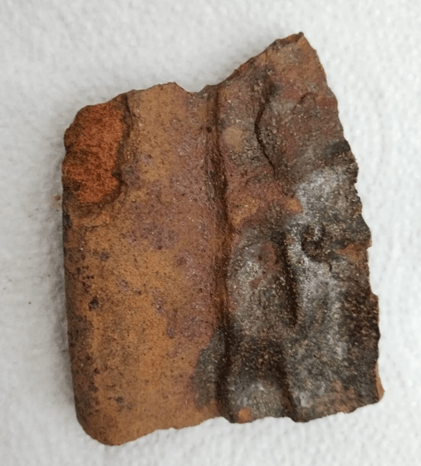
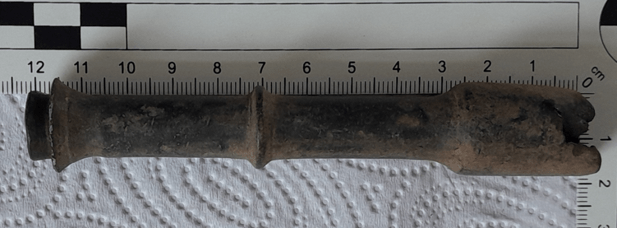
In 2024, during the summer dig, we re-opened the original trench which had been back-filled some years earlier, and extended it to the north-east and south-east. Within a section of undisturbed ditch on the north-east side of the trench, a large piece of Tudor ceramic and a brick which appears to date to the same period were found. These artefacts lay just under the stone capping of the bank, thus dating the bank to the Tudor period or earlier. A Tudor candlestick was also found close to this trench later that same year.
The large piece of Tudor ceramic found during the 2024 summer dig, with the imprint of the potter’s fingers on the rim.
The Tudor candlestick found in 2024.
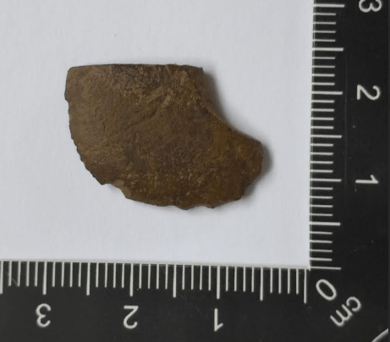
We are now trying to ascertain how far the bank and ditch run to the north-west so we are continuing to expand in this direction. Finds in the last few weeks have included a piece of clay pipe, a sherd of medieval or Tudor green-glazed ceramic, and what appears to be a stone scraper, which may be mid-to-late Mesolithic.
The possible prehistoric scraper found recently.
It appears that the bank and ditch also runs for some distance to the south-west, possibly linking up with a section of low bank still apparent in the next field, which forms one side of a roughly square enclosure; a few years ago, a minor excavation (down to, but not into, the archaeology) within this enclosure uncovered what we think is a furnace, which awaits future examination.
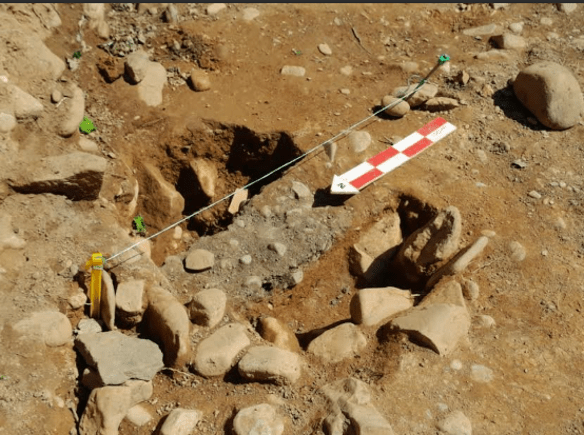
Approximately 75 cm under the section of bank in which the Tudor ceramic and brick were found, we also found the base of a substantial post-hole, roughly oval, with a diameter of approximately 48cm and a length of approximately 50cm and surrounded by large packing stones. This post-hole is therefore earlier than the bank and ditch. It may have formed part of the foundation of a wall, as it appears to be associated with a line of large stones which runs in a roughly east-west direction. We do not have dating evidence for these earlier features yet and excavation is ongoing.
The base of a large post-hole recently discovered.
We hope to continue with this excavation during the summer. Anyone interested in joining us, please email us at caeralyn7@gmail.com
.

